


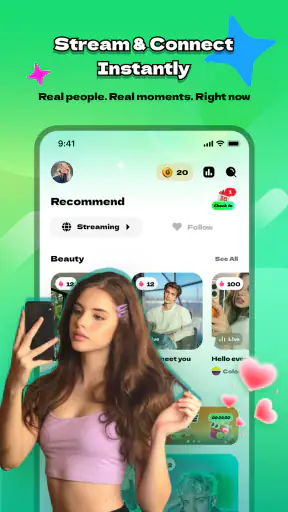
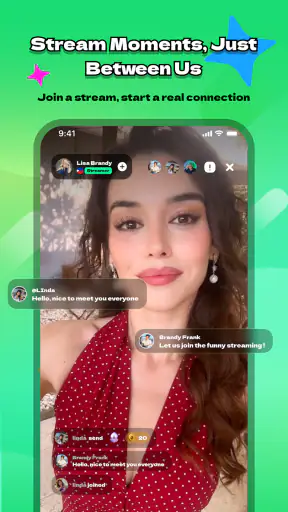
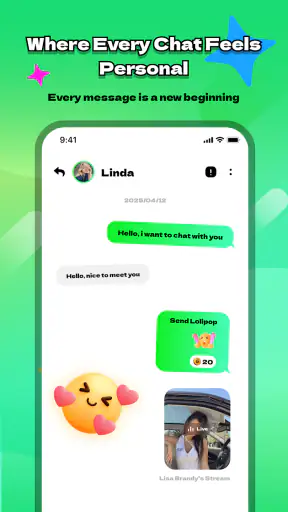
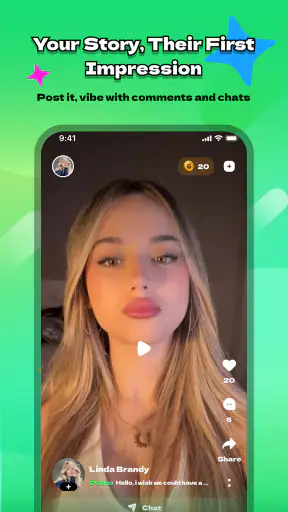
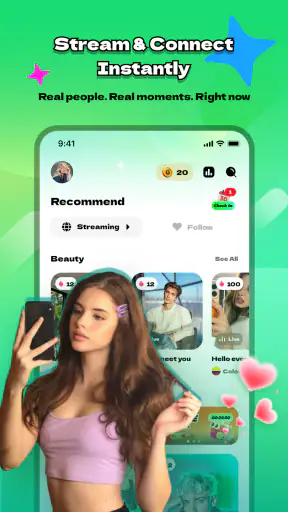
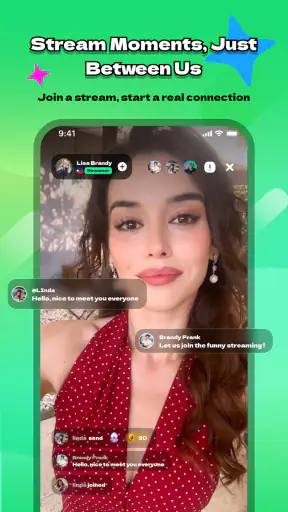
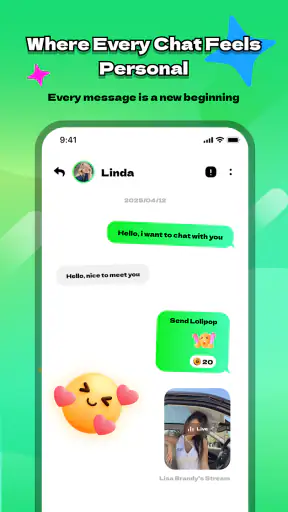
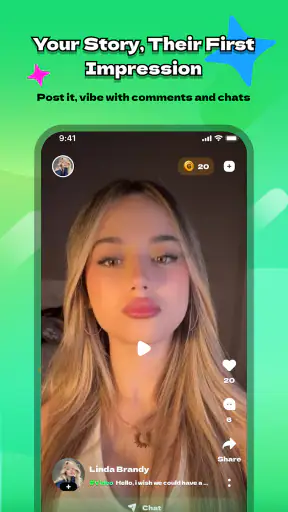
I spent time with Gela: Live Your Global Moment as a social app built around live interaction rather than a traditional feed. Its focus is immediate streams and real-time participation, so the experience feels closer to dropping into an ongoing conversation than scrolling through carefully edited posts. That difference matters: Gela is most appealing when I want something happening now, not when I am looking for a quiet archive of photos, messages, or long-form updates.
Developed by WarmLink Company, Gela is free to install and sits in the mature social category. The app has reached over a million installs and holds a 4.6 average from roughly seven thousand ratings, which suggests that its central live-streaming idea is connecting with a sizeable audience. It is currently at version 1.6.5, and that makes the app feel like a product still being shaped rather than a completely settled social platform.
How Gela feels in everyday use
The first thing I noticed is that Gela asks for a different kind of attention from the usual social networks. A standard feed lets me pause, skim, return later, and decide how much time to give each post. Live streams are less forgiving. When I enter one, the appeal comes from the sense that something is unfolding while I am there. I have to make a quick decision about whether the host, topic, or atmosphere is worth staying for.
That immediacy is also the app’s strongest advantage. If I have a few spare minutes after work, I can open Gela and look for an active stream instead of waiting for friends to post something new. The experience works particularly well for people who enjoy discovering personalities and conversations without needing a formal introduction. It is easy to feel like a quiet observer at first, then become more involved if the room feels welcoming.
At the same time, live content can be uneven. A stream may be entertaining one minute and slow the next, and the quality depends heavily on the individual host. This is an important trade-off for anyone comparing Gela with an image-based network or a messaging app. Those alternatives usually offer more control over timing and presentation. Gela’s charm comes from spontaneity, but spontaneity also means less consistency.
A practical evening scenario
Imagine finishing dinner and wanting light company while doing something else. I would open Gela, browse the available live activity, and enter a stream that matches my mood. I might stay only long enough to understand the conversation, or I might participate if the interaction feels natural. This is a better fit than opening a private messenger when nobody is available, because the live environment gives me a chance to find activity without arranging it in advance.
For someone who enjoys meeting people from different backgrounds, that same scenario can become a form of casual discovery. The global angle makes the app feel broader than a closed circle of existing contacts. However, I would not treat it as a replacement for close friendships. A live room can provide presence and conversation, but it does not automatically provide the trust, privacy, or continuity of a personal chat.
What the current version tells me
Version 1.6.5 is the clearest sign that WarmLink Company is continuing to refine the experience. I see that as encouraging, but I also approach it with realistic expectations. A relatively young live-social product may change its navigation, interaction patterns, or balance between discovery and participation as more people use it. The current version should therefore be judged as the experience available now, not as a promise of every feature the platform might eventually add.
The release date, July 14, 2025, also places Gela in an early stage compared with long-established social services. That gives it room to develop a distinct identity, but it means users should expect some rough edges. I would be comfortable trying it as a secondary social app while keeping my main communication tools for conversations that need reliability and continuity.
The store summary describes the product as “Instant Streams, Real-Time Fun,” but my impression is more nuanced. Instant access is genuinely central to the experience, yet the fun depends on finding the right stream and accepting that not every session will be memorable. The short store description is simply “Gela,” which says little about how the app works; the live-social format is what really determines whether it suits you.
Changes and what they mean for existing users
For people who already use Gela, the move through its current version should be viewed as product evolution rather than a reason to expect a completely different service. The important question is whether the basic live-streaming loop remains useful: open the app, discover active content, decide where to spend time, and participate at a level that feels comfortable.
Existing users benefit most when they treat the app as a flexible drop-in space. I would not build my entire social routine around it, but I would return when I wanted live interaction without planning a call or waiting for a friend to post. That workflow reduces pressure. I can be present without committing to a long conversation, and I can leave without creating the awkwardness that sometimes comes with ending a private chat.
There is a less obvious adjustment for returning users: live platforms reward timing. A person who opens Gela at different parts of the day may encounter very different energy, hosts, and conversations. If the first session feels quiet, I would not immediately conclude that the app has nothing to offer. I would try another time and use shorter visits to learn when the experience feels most active for me.
Another useful habit is to separate discovery from commitment. I would sample a stream before becoming deeply involved, especially if the room has a fast pace or a large audience. That approach helps me avoid spending too long in a session that does not match my interests. It also makes the app feel less demanding than treating every stream as something I must follow closely.
Where Gela stands against familiar alternatives
Compared with a conventional social feed, Gela is more immediate and less polished. A feed is better when I want to catch up on people I already know, save interesting posts, or browse at my own speed. Gela is better when I want the feeling of entering a live room and seeing what is happening without waiting for a curated update.
Compared with private messaging, Gela offers easier discovery but less personal control. Messaging is the obvious choice for sensitive details, planned conversations, and relationships that already exist. Gela makes more sense when I want open-ended interaction and do not mind that the people or topics may be unfamiliar.
Compared with established live-streaming platforms, Gela’s appeal is its focused identity as a social meeting place. I would choose a larger specialist platform if I wanted a mature creator ecosystem or a highly organized content-search experience. I would choose Gela when the priority is a lighter, more spontaneous way to encounter live social activity. The smaller, newer feel can be refreshing, although it may also mean that the experience varies more from one session to another.
Costs, age suitability, and personal boundaries
Gela is free to download, which makes trying it straightforward. It includes optional purchases ranging from less than a dollar to almost a hundred dollars per item. That wide range is something I would take seriously, especially in a live environment where excitement and social pressure can build quickly. I would decide on a spending limit before using any optional purchase rather than making decisions in the middle of an energetic stream.
The mature seventeen-plus rating is equally important. I would not recommend treating Gela as a general-purpose app for younger teenagers. Adults should still use ordinary online judgment: avoid sharing identifying details too quickly, be cautious with people who push for private contact, and leave any interaction that feels manipulative or uncomfortable. The live format can make conversations feel personal faster than they really are.
One practical tip is to keep the app’s social enjoyment separate from financial participation. I can watch, listen, and decide whether a community suits me without spending anything. That is the healthiest starting point for a free app with optional purchases. If I later choose to buy something, it should be because I understand what I am paying for and not because a momentary interaction makes me feel obligated.
Remaining friction and who should skip it
My main reservation is that Gela’s value depends on the quality and availability of live activity at the moment I open it. There is no guarantee that every visit will produce a conversation I want to join. People who prefer predictable content, detailed search tools, or a strong record of saved posts may find the format frustrating.
I would also skip Gela if my primary goal were private communication. A dedicated messenger is a better choice for family updates, work coordination, or anything that needs a clear recipient and an easy history. Likewise, someone who dislikes spontaneous interaction may enjoy a traditional feed more, because it gives greater control over when and how to respond.
The app is a weaker fit for anyone who expects every social interaction to be meaningful. Live rooms can be casual, repetitive, or driven by the mood of the moment. I see that as part of the format rather than a defect that can be completely removed. The right mindset is to treat Gela as an opportunity for real-time discovery, not as a guaranteed source of deep conversation.
What I would watch as the app develops
As WarmLink Company continues working on Gela, I would watch how the app balances openness with a comfortable user experience. Discovery needs to be lively enough that new users can find something worth joining, while participation needs to feel manageable rather than overwhelming. The best future improvements would strengthen that balance without turning the app into a copy of a larger social network.
I would also pay attention to how clearly the app communicates its optional purchases. In a live setting, transparency matters because users are making decisions while engaged with other people. Straightforward presentation would help preserve trust and make the free experience feel complete rather than like a preview of a paid one.
Another area worth watching is consistency across visits. Gela will be more useful to me if I can develop a reliable routine for finding the kind of streams I enjoy, while still retaining the surprise that makes live discovery interesting. Too much structure could remove the spontaneity; too little could make the app feel random. That is a difficult balance, and it will shape whether people keep returning.
My recommendation
After using Gela, I see it as a promising social option for adults who enjoy live interaction and do not need every conversation to be planned. Its free entry point makes experimenting easy, and its current scale suggests that it has already attracted meaningful interest. I like the feeling of dropping into an active moment, especially when I have time for casual company but no specific person to contact.
I would recommend trying it with modest expectations and clear boundaries. Give it a few short sessions rather than judging it from one quiet visit, and remember that the quality of the experience depends on the live rooms available when you arrive. Keep optional spending deliberate, and use a private messenger when privacy or continuity matters more than discovery.
My honest verdict is that Gela is worth trying as a spontaneous live-social companion, not as a complete replacement for every other social app. If you want real-time encounters and the possibility of meeting people beyond your existing circle, it offers a distinctive reason to return. If you want a calm, predictable, private, or carefully archived social experience, one of the usual alternatives will probably serve you better.


